
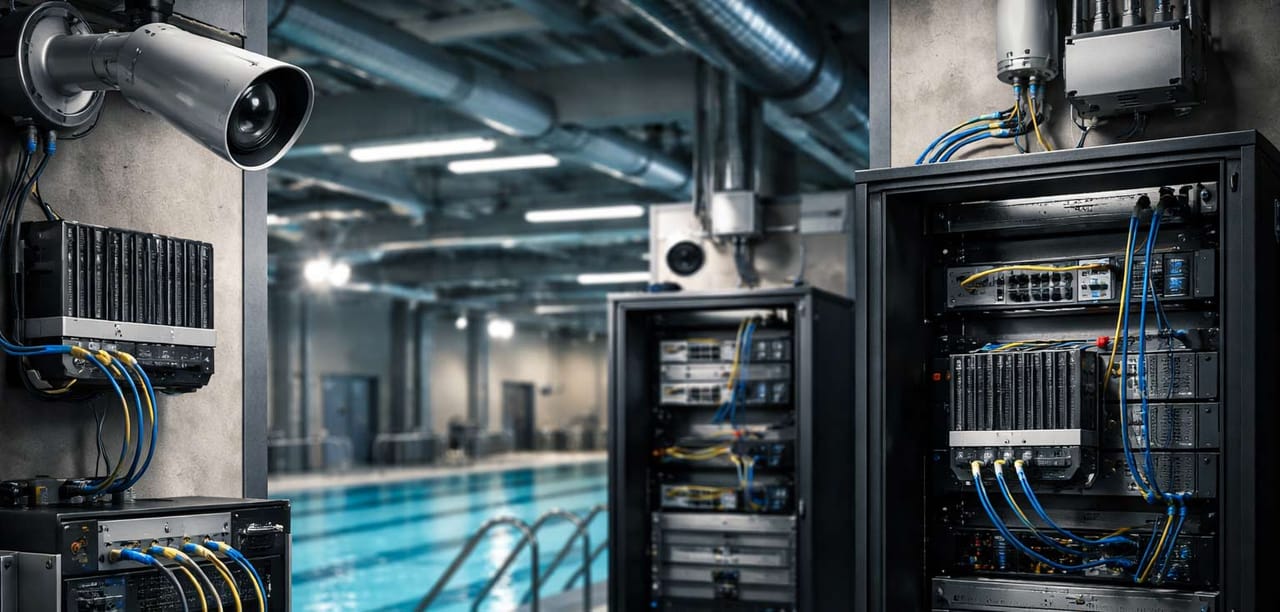
System architecture

System architecture

Designed for critical environments

Architecture

Aqutron Vision is designed as a system architecture, not as a set of independent functions. This choice is not only technical but strategic: in high-responsibility environments, the difference is not “what the system does”, but how governable, verifiable, and sustainable it is over time. The architecture defines clear roles, precise boundaries, and explicit responsibilities, reducing operational ambiguity and facilitating the platform’s evolution.

Decisions near the data, control near responsibility

The system operates primarily with edge processing, directly at the facility.

Critical evaluations occur where data originates, without structural dependence on cloud services or external connectivity.

This approach enables reduced latency in risk assessments, operational continuity even in degraded conditions, and greater control over data flows and exposure surfaces.

It is not a performance choice, but a choice of control and responsibility.

Context-oriented multi-source integration

Aqutron Vision integrates heterogeneous sources — vision, sensors, plants, and operational systems — into a coherent model of the facility state.

The value is not in the single data point, but in its contextualisation: a presence is relevant only under certain conditions, a behaviour is anomalous only relative to a known context, and an event becomes critical only when placed within a verifiable temporal dynamic.

This correlation capability reduces arbitrary interpretations and supports more explainable and proportionate decisions.

Privacy-by-design and GDPR as an architectural choice

In sensitive environments such as swimming pools, privacy is not an accessory requirement.

Aqutron Vision architecture is designed according to privacy-by-design and data minimisation principles, making support for GDPR requirements technically sustainable rather than relying solely on organisational procedures.

In practice: processing occurs locally (edge), biometric recognition or personal identification is not required, the purpose is operational safety and not surveillance, and data flows are controllable and delimited.

This approach reduces privacy impact and simplifies processing governance in real-world usage contexts.

Modularity and controlled growth

Each function is implemented as an independent module, activatable or extensible without modifying the entire system.

This allows starting with a defined operational scope, adapting the platform to different facilities, and introducing new functions without increasing overall complexity.

Scalability is not synonymous with uncontrolled expansion, but with governed growth.

Traceability, audit trail, and operational trust

In regulated contexts, “working” is not enough.

The architecture is designed to make events, decisions, and flows traceable, supporting audits, checks, and organisational responsibility.

Every decision is contextualised.

Every action is reconstructible.

A technological foundation that enables the future

Aqutron Vision is not built for a single use case.

The same architecture supports pool safety, preventive safety, energy optimisation, and operational decision support.

It does not impose a way of working.

It provides a more solid, controllable structure ready to evolve with facilities and regulations.

Powered by Synanext Vision Platform™ — the foundational layer providing the data model, governance, and operational discipline for Aqutron Vision.